Showing posts with label New York. Show all posts

November 23, 2010

Bikes and Cars: Framing the Debate

The NYTimes reports that New York City is soliciting proposals from companies to implement a bikeshare program.

The City has already completed a thorough documentation of how such a plan might work, and Transportation Commissioner Janet Sadik-Khan has busily invested in infrastructure necessary to making the bicycle a safer and more convenient choice for millions of Manhattanites. And now the rubber is hitting the proverbial road.

I don't always blog about non-Bay Area projects, but the article paraphrased a common critique of bike sharing specifically, and biking more generally, without refuting it:


The city first floated the idea of a bike-sharing program in 2008, but some officials were said to have expressed reservations about giving over city streets and sidewalks to a program that would require a sizable footprint.
In Paris, for instance, parking spaces were removed to make way for hundreds of rental kiosks.
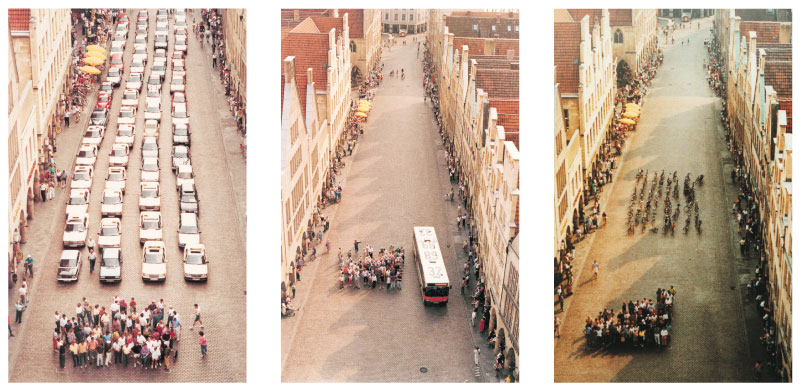
Sizable footprint? Sizable footprint!?!? The amount of space a bike sharing kiosk needs to operate is tiny, infinitesimal compared to the amount of space needed for car storage or public transit storage.

A picture makes my point most efficiently:


Moving people efficiently, adding capacity efficiently, reducing pollution, increasing exercise, I could go on: does not come with cars. Complaining that bikes have a sizable footprint while cars are somehow so unquestioned, so taken for granted as permanent fixtures that their impact goes unmentioned is willfully ignorant.

September 23, 2010

Segregation and cities

One area of urban planning that I have both read a lot about, in the sense that it exists, but have not read anything about, in the sense of what a planner can/should do about it, is segregation.

h/t to Ms. AK from Seattle for the link to these illuminating population maps. Just goes to show how far a good visual can go. I've posted three, but a few more are here.

Red/pinkish dots = white people, blue dots = black, green dots = asian (presumably east asian, judging by the Chinatown clusters, unknown how much of Asia is included though), and yellow = hispanic/latino.

San Francisco - lots of white people in north and central SF. Interesting integration in what looks to be either downtown Oakland or Berkeley, can't quite tell. It's one of the few places on any map where all colors can be seen mixed together.

Detroit - the 8 mile road is like the Berlin Wall. Wow. Inner city is black, outer ring, white.

New York City - the famous neighborhoods. Little thises and thatses, and boy are they concentrated. Notable that Central Park and Prospect Park, the two best known (and used) parks, are pretty much surrounded by white people. Assuming I've noted the correct location for Prospect. I guess that shouldn't really come as much of a surprise.

These maps = me looking forward to learning GIS.

August 27, 2010

Hat Tip/Finger Wag

Tip of the Hat to:


NYCDOT's Park Smart program, which raises the price of on-street spaces when demand is highest, has helped more people find parking in Park Slope while relieving the traffic caused by cruising for a space, according to new data released by the agency.

As intended, during the peak period, the average amount of time that drivers parked in the pilot area decreased significantly, according to DOT's analysis.

Higher turnover means more customers for the shops and restaurants that line each of those corridors. DOT surveyors counted a 17 percent increase in the number of unique vehicles parked along Fifth and an 18 percent increase along Seventh.

In neighborhoods like Park Slope, where a Transportation Alternatives study found that more than half of all traffic consists of endless cruising for a free space, Park Smart also serves as a congestion killer. During the peak period, traffic volumes dropped by five percent on Fifth and nine percent on Seventh. Traffic is down even as more people are able to reach Park Slope by car, a rare combination.


Wag of the Finger to:
 

If you live in CA, or read economic news at all, you know that CA = big budget deficit. So why the assembly approved--by a 48 to 8 margin--a penalty reduction for people breaking traffic laws defies common sense. Bill sponsor Jerry Hill (D-San Mateo) poses the same issue on his own website:

"As budget negotiations continue, I would like your feedback on the proposals being discussed to close California's $19 billion deficit."

Hmm ... how about tens of millions in revenue from drivers who are ticketed for breaking the law?