Showing posts with label Bus. Show all posts

March 9, 2011

Dept. of Fun Things to Do at a Bus Stop

Earlier this year, Clear Channel ponied up to install digital screens at 20 different bus stops across San Francisco. Like, big digital screens.

Clear Channel's incentive: advertising revenue. Clear Channel shoulders the implementing costs, pays Muni for the bus stop space, and then rents out the screens to companies like Yahoo, which sponsored a month-long Bus Stop Derby. While waiting at bus stops, patrons could tap-activate the touch screen, sign in as a representative for x neighborhood, and play live games against people at other bus stops. The winner accrued points for his/her neighborhood, and ... one month later, North Beach has been crowned victorious (tourists?), followed by the Tenderloin. I have this image of legions of bums (with, you know, lots of free time), gradually ascending the digital learning curve and accumulating points by virtue of sheer hours played.

Anyway, something worked, because Clear Channel is expanding the digi-screens to DC.

Big screens, yo. And I'm stuck with County Connection, where you're lucky to have a bench.

Locations of the different interactive bus stops. Even though most sites are concentrated in the Financial District, players anywhere can sign in for any neighborhood.

January 13, 2011

In a station of the metro

The apparition of these faces in the crowd;
Petals on a wet, black bough.

The woman who drives the route 21 southbound bus that arrives at Railroad and San Ramon Valley Blvd at 7:55, weeknights, has the nicest smile of any bus driver in the Bay Area. She doesn't say anything, but she always smiles. I only ride that route once, maybe twice a week--only when my tutoring sessions at the Library end at 7:40ish--so I have yet to ask her name. But I think we recognize each other now; I always board at the same stop.

My sister has just pronounced riding the bus in Danville, "weird." This from a young woman who rides the bus on a mostly weekly basis in Salem, Oregon, where she is a carless college student with an off-campus internship. And her mindset is common, perhaps endemic in car-dependent places like Danville, where children are raised in the backseat of automobiles. That's what I was used to; I had never set foot in a Danville bus before last August and the thought of waiting at the bus stop, or of actually being a bus rider (who are those people!) gave me the howling fantods. Especially the kids who used to take the bus to school. They were a tainted race. Habits! Habits die-hard.

The 21 driver picking up at BART at 6:00 asks his regulars: "did you leave a phone on the bus last night?" Dissenting answers. The time nears 6:00, one more man boards, and the answer is "yes!" An explosion of good cheer as giver and getter of good deed meet.

According to my dentist, I am truly my "father's son" because we are the only two patients who ever bike to appointments. I feel like a role player in an ensemble cast. "The bike guy." Better: "Biking son of biking dad." My students think of me that way too, as some kind of interesting local flavor: perplexed that I ride the bus, astonished that I bike so far! (3 miles) when it is so cold! (like 40). But then they soften it with, well, it probably saves money on gas. And I add, I like to read and doze on the bus. Hmm, they say. Yeah.

A man sitting behind me on the bus ride home (woman with the smile at the wheel) answered his phone. "Hello. I'm on my way. I'm doing the best I can so don't bitch at me thank you bye bye."

January 9, 2011

Transforming a City

If you have 25 minutes, this PBS documentary about the work and legacy of Enrique Peñalosa, former mayor of Bogatá, is well worth a watch.

Transportation investments under his watch have improved the quality of life and reduced the crime rate for a city that used to be synonymous with danger and drug cartels.

Watch the full episode. See more e2.


Before the video starts there are 2 short ads ... do not lose heart! Plus, Brad Pitt narrates.

November 29, 2010

Department of Pipe Dreams: Highway 680 Bus Rapid Transit, Pt I

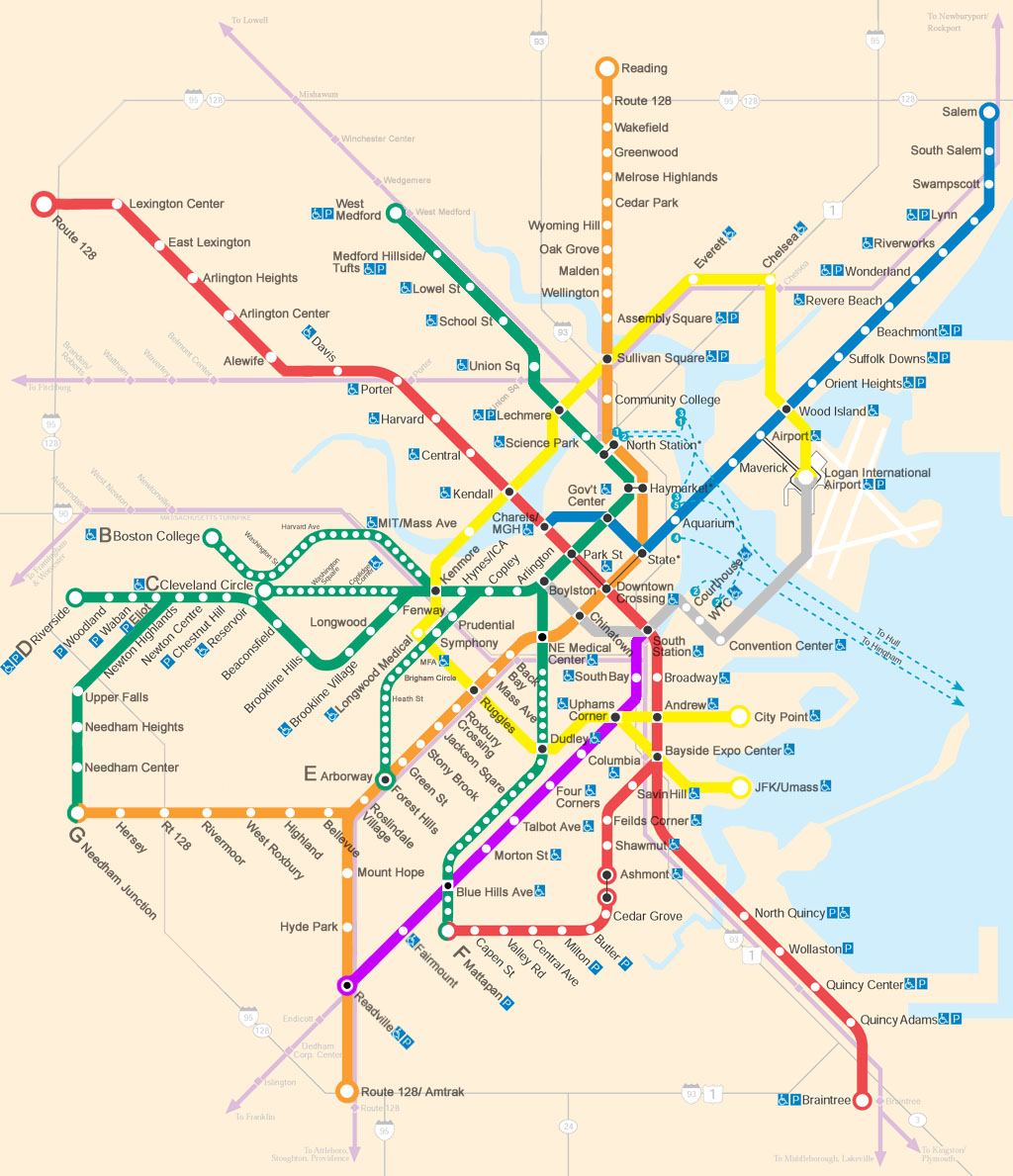
Making fantasy transit maps is a favored pastime of at least a few urban planning bloggers, but I must confess this pipe dream was dreamed well before I read about Transbay's dream Bus Rapid Transit plans, mega MTA, or a Boston with an MBTA urban ring. Goes to show that fantasy is a standard, and seductive, business.

In this post I'll give a general overview of why a BRT line linking West Dublin/Pleasanton BART and Walnut Creek BART in the Highway 680 right of way would be a good idea, if wishes were horses. In Part II, I'll go into more detail about Bus Rapid Transit particulars, individual station locations and treatments, what kind of feeder bus networks would be needed, and what incentives and enhancements could boost hypothetical ridership.

The Pitch

Interstate 680, north of 580 and south of 24, is clogged with traffic, especially during commuter rush hour. Large sections of it are built out, making expansion difficult. The Walnut Creek BART Station in the north and Dublin/Pleasanton Station in the south take commuters into Oakland and San Francisco, but full parking lots and underused buses limit station capacity. The area in between the stations is a transit desert, served only by a scattering of County Connection bus lines. These bus lines already use the two BART stations as convenient route termini, but rely on the anonymous, tucked away, San Ramon Transit Center for their origin. Housing developments and sprawl continue at the edges of existing development, further impacting 680. Cities and towns surround 680, yet the corridor lacks density or sheer population to justify a BART connection. (BART is already in trouble for expensive boondoggles, landing on the wrong side of violent and financial civil rights disputes, and being politically obligated to build out to inefficient locations because those locations happen to contribute revenue to it.) 680 is the principal artery for the region, a necessity to get to either BART station, anywhere else in the Bay Area, and many local trips.


BRT on 680 would fill in the gap between D/P and Walnut Creek

Note how developments are concentrated around 680, but spreading eastward in San Ramon/Danville. BART Stations are located where 680 and 24 intersect in Walnut Creek, and 680 and 580 intersect in Dublin.


The Overview

Bus Rapid Transit for the 680 corridor would link the under-construction West Dublin/Pleasanton BART Station to the Walnut Creek Station. It would have its own dedicated right of way for the duration of the route, off board fare collection, and triple-door low floor buses (or raised platforms) to facilitate minimal holding times at stations. To cater to business commuters, the buses could offer wireless internet. Stations will be built around intersections where 680 crosses over or under major suburban arterials.

Like this, Transmilenio style (Bogotá, Colombia)

Investing in the highway right of way would centralize and reorient bus operations into a main trunk route fed by feeder buses. Feeder buses would run along the high-volume arterials that traverse the region--streets like Crow Canyon, Bollinger Canyon, Ygnacio Valley, and Stone Valley Roads. Users would need to get to the nearest arterial, and from there, using the system would intuitively mimic how they already move around the region: accessing and exiting 680.

While BRT could certainly be used for a variety of daily trips, its largest value-add will be for commuters traveling out to Oakland and San Francisco, or commuters coming in to the office parks in San Ramon and Pleasanton. BRT's guaranteed traffic-free ride to BART will reduce incentive to both a) drive to BART, and b) drive to the final workplace destination, taking cars off the road and diminishing rush hour traffic.

Stay tuned for the list of stations and locations of feeder routes!

November 23, 2010

Bikes and Cars: Framing the Debate

The NYTimes reports that New York City is soliciting proposals from companies to implement a bikeshare program.

The City has already completed a thorough documentation of how such a plan might work, and Transportation Commissioner Janet Sadik-Khan has busily invested in infrastructure necessary to making the bicycle a safer and more convenient choice for millions of Manhattanites. And now the rubber is hitting the proverbial road.

I don't always blog about non-Bay Area projects, but the article paraphrased a common critique of bike sharing specifically, and biking more generally, without refuting it:


The city first floated the idea of a bike-sharing program in 2008, but some officials were said to have expressed reservations about giving over city streets and sidewalks to a program that would require a sizable footprint.
In Paris, for instance, parking spaces were removed to make way for hundreds of rental kiosks.
Sizable footprint? Sizable footprint!?!? The amount of space a bike sharing kiosk needs to operate is tiny, infinitesimal compared to the amount of space needed for car storage or public transit storage.

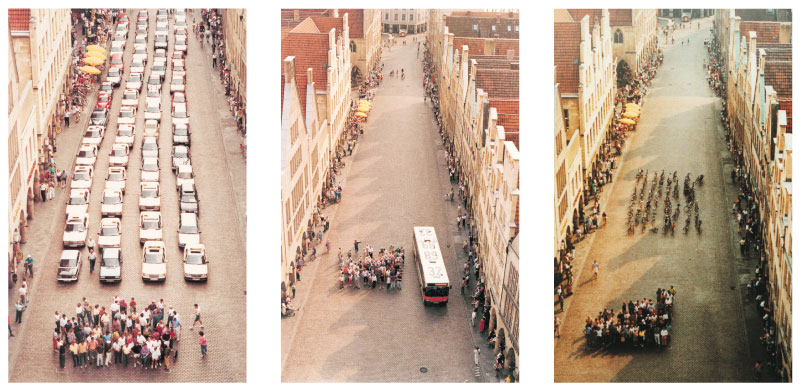
A picture makes my point most efficiently:


Moving people efficiently, adding capacity efficiently, reducing pollution, increasing exercise, I could go on: does not come with cars. Complaining that bikes have a sizable footprint while cars are somehow so unquestioned, so taken for granted as permanent fixtures that their impact goes unmentioned is willfully ignorant.

October 20, 2010

Real time bus arrivals

Straight Outta the Suburbs throws a spotlight on the Long Beach Transit Authority's work to install real-time bus arrival screens at its bus stops. 44 stops and counting now have digital screens that display when the next bus will actually arrive, thank to GPS technology.

What jumped out at me was the production quality of the LBTA's promo-video for the technology, which it calls "TranSmart System". While I think the video doesn't provide quite enough information about what users can expect from the TranSmart, it's an envelope-pushing attempt to brand bus-riding. This matters a lot, and is rarely done right. (See the Contra Costa County Connection's youth video in the uh-oh column, and Boulder, Colorado in the ace column.) At the same time, it also screams the LA stereotype that image is everything.

In any case, all self-respecting, well-used (sorry, CCCC) bus systems should aggressively pursue real-time technology.