Showing posts with label Financing Sustainability. Show all posts

February 7, 2011

Growth and the Role of Rail

When the cost of HSR is discussed in that way that makes it seems formidably, unAmericanly expensive, the context of HSR's pricetag is rarely established: i.e., that if rail does not happen, many billions will be spent, regardless, on freeways and airports. Obviously, rail does not end the need to spend billions of dollars on roads, freeways, and parking, but it relieves congestion and saves the expenses of expanding those networks. The San Antonio Express-News gets it right:

According to a study commissioned by the Texas Transportation Commission, during the next 20 years, more than $300 billion in 2009 dollars needs to be invested in Texas roads and freeways just to keep commute times from worsening. Adjust that figure for expected inflation and the cost balloons to $488 billion.
The gasoline tax, which provides most of the funding for road construction and maintenance, is expected to provide only $160 billion in revenue during the same period. Legislative leaders have characterized the state's transportation funding as a crisis: Texas is running out of money to build new roads.
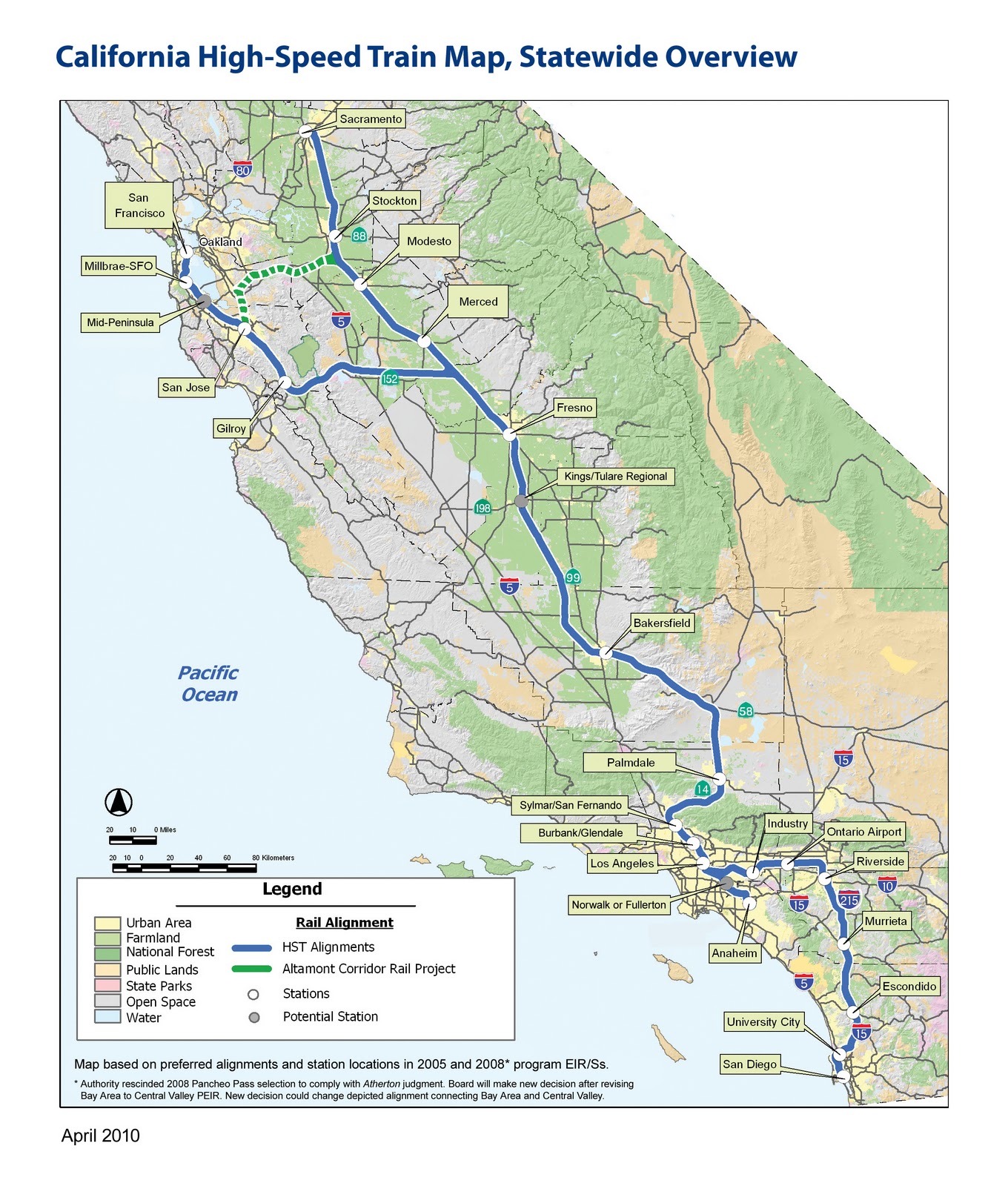
California, long maligned as the golden state of governmental malaise, has embarked on a different path. In 2008, California voters approved $10 billion in bonds as a down payment on a $40 billion high-speed rail system that will link San Diego to Los Angeles and Los Angeles to San Francisco and Sacramento via the Central Valley.

Eventually public transit becomes cheaper (and more attractive) than continuing to expand road networks. Los Angeles hit a breaking point: look at the popularity/buzz around Villaraigosa's 30/10 plan to expand transit in Los Angeles. I hope more cities and states see those costs, too, and mobilize in favor of transit.

A good place to start would be spreading an appreciation for the fact that Caltrains saves 2.5 lanes of traffic on 101 during each commute. Is it more expensive to add miles of highway or close a $30 million operating budget for the beleaguered rail agency?

January 25, 2011

State to Audit Redevelopment Agencies

CA announced today that it will audit redevelopment agencies as part of the information gathering process leading to their elimination or preservation.

Regardless of the fate of these agencies, audits and greater accountability are good. End of story.

January 23, 2011

Proposition 26: Negative Fallout

Last fall, CA voters approved Proposition 26, an initiative that requires all new state taxes and fees be approved by a two-thirds majority by each house of the state legislature.

The November passage of Proposition 26 threatens a complicated 2010 gas-tax swap that reinstated California’s transit assistance program.
Since that deal involved an increase to the state’s excise tax, it must be re-enacted with a two-thirds majority of the Legislature, according to Jessica Digiambattista of the Legislative Analyst’s Office.
If the reauthorization is not approved, transit agencies will suffer. The San Francisco Municipal Transportation Agency could lose about $31.5 million and BART about $23 million. Caltrain could miss out on about $4.5 million and SamTrans some $4.6 million.

"[A] complicated gas-tax swap" is right. From what I can gather, it seems like the gas-tax swap reduced the overall funds available to public transit by replacing an out-and-out gas sales tax with an excise tax. Because of Proposition 26, that increase in excise tax must be retroactively approved by a 2/3s majority--irregardless of the fact that it was paid for by eliminating the sales tax. (To keep the gas-tax swap palatable, the overall package is revenue neutral, i.e., no net change in state $$ intake or outflow.)

Madness!

Here's a quick selection of explanatory bits from the Bay Area Metropolitan Planning Commission website. Hard to nushell this one, other than that it seems enabled by imaginative accounting, and is probably motivated by a desire to free up monies in the General Fund. (I also want to guard against the strong possibility that any summary by a non-expert will misrepresent the facts at hand, so I'll let them speak for themselves.)

Mechanics of the Tax Swap

The bills (AB 6 and AB 9) provide the General Fund with approximately $1.1 billion by shifting the cost of debt service on outstanding transportation bonds from the General Fund to various transportation funds. Relieving the General Fund of these interest obligations results in approximately $11 billion in General Fund savings over the next 10 years. 
The tax swap, contained in AB 6, affects four different taxes — the state portion of the sales tax on gasoline, the excise tax on gasoline, the state portion of the sales tax on diesel fuel, and the excise tax on diesel. Local sales taxes remain unchanged and will continue to include gasoline and diesel fuel. AB 6 contains the following key changes:
  • Beginning July 1, 2010, eliminates the 6 percent statewide sales tax on gasoline, and with it, the funding source for Proposition 42 (the 2003 constitutional amendment that required most gasoline sales taxes to go to transportation) and “the spillover,” a funding formula dedicated to public transit.
  • Raises the excise tax on gasoline by 17.3-cents on July 1, 2010, for a total excise tax of 35.3 cents per gallon. Starting March 1, 2011, and each March 1st thereafter, authorizes the State Board of Equalization (BOE) to estimate how much revenue would have been raised by the sales tax on gasoline and adjust the gasoline excise tax to raise an equivalent amount.
  • Retains the existing sales tax on diesel fuel and raises it by another 1.75 percent on July 1, 2011 to generate about $120 million in additional funds for public transit, for a total of approximately $436 million in FY 2011-12.
  • Offsets the diesel sales tax rate increase by lowering the diesel excise tax from 18 cents per gallon to 13.6 cents, effective July 1, 2011. Similar to the gasoline excise tax, the excise tax would be adjusted by the BOE on March 1st of each year to maintain revenue neutrality.

Public Transit Bears the Brunt of General Fund Savings

While the overall tax swap is revenue neutral by design (in order to allow for passage by a simple majority vote), public transit loses over $1 billion annually due to the elimination of the sales tax on gasoline, as discussed in greater detail below. AB 9 also appropriates $142 million in Public Transportation Account (PTA) funds to the General Fund to offset the cost of public transit bond debt service in FY 2009-10 and another $254 million for FY 2010-11.
 ...
AB 9 stipulates how the excise taxes on gasoline and diesel fuel — and the sales tax on diesel — will be distributed, and appropriates $400 million to the State Transit Assistance (STA) program, the only source of state support for public transit operations.

Raw. Deal. Why the gas-tax swap needs reauthorization when it was signed in March of 2010, and Prop 26 was passed in November of 2010, is beyond me.

January 20, 2011

Things You Don't (always) Think About

From a SJ Mercury op-ed about Caltrain's importance to Stanford. Caltrain is facing a $30 million budget shortfall next year.

Losing Caltrain service would cripple our regional transportation system and economy, limit mobility and employment options and require 2.5 additional highway lanes between the South Bay and San Francisco to keep the commute flowing at current levels, according to UC Berkeley professor of city and regional planning Elizabeth Deakin.

I think we can all agree that adding a minimum of 24 feet to several hundred miles of freeway (hundred: there are multiple freeways serving the 50 mile stretch between SF and SJ, 280 and 101 being foremost) would cost substantially more than $30 million. Just sayin.

Glad to see that Stanford is getting ink for leading the charge to find Caltrain funding.

Ascertainable Fact: Sprawl Neither Demanded nor Profitable

Not demanded:

(From the WSJ. Italics mine. Bolding mine. Underline mine.)
Much of this week’s National Association of Home Builders conference has dwelled on the housing needs of an aging baby boomer population. But their children actually represent an even larger demographic. An estimated 80 million people comprise the category known as “Gen Y,” youth born roughly between 1980 and the early 2000s. The boomers, meanwhile, boast 76 million. (And, uh, we're gonna outlive them.)
Gen Y housing preferences are the subject of at least two panels at this week’s convention. A key finding: They want to walk everywhere. Surveys show that 13% carpool to work, while 7% walk, said Melina Duggal, a principal with Orlando-based real estate adviser RCLCO. A whopping 88% want to be in an urban setting, but since cities themselves can be so expensive, places with shopping, dining and transit such as Bethesda and Arlington in the Washington suburbs will do just fine.

Count me in that 88%, obvi. I'm wracking my brain for a peer to (anonymously) trot out as a counterexample, but I can't.

Not Profitable:

Transportation for America breaks down a report indicating that these Gen-Y preferences (density, infill, transit-links, walkability) have big economic bonuses:

In Dallas, Texas, for instance, downtown retail sales rose 33 percent the year after the new light rail system began operation. Portland, Oregon attracted $3.5 billion in private investment after just $100 million in streetcar funding. In Sarasota, Florida, downtown development costs clocked in at just half the cost of new development in the suburbs and generated four times the revenue in tax receipts.
Denver, Colorado perhaps best exemplifies the market for new approaches to growth and transit. Home values for Denver residents within a half-mile radius of the Southeast light rail line increased by 18 percent just as home values in the remainder of Denver declined by 18 percent, between 2006 and 2008. Nationwide, one study found that every one-point increase in a home’s “walk score” — a measure of how accessible the area is by foot — corresponded with a $700 to $3,000 increase in property value.

January 18, 2011

Toward More Reliable Financing for Mixed-Use Development?

Not out of the woods yet, but it appears momentum is growing to create a more reliable source of funding for mixed-use developments. An alphabet soup coalition of National Association of Home Builders (NAHB), Congress for the New Urbanism (CNU), and the National Town Builders Association (NTBA) is pushing for Fannie, Freddie, and HUD to guarantee mortgages for a more diverse, incl. mixed-use, portfolio of real estate. 

A Big Urban Victory – Mixed-Use and Fannie, Freddie and the FHA
The board of the National Association of Home Builders (NAHB) has approved a resolution that could have a dramatic impact on urban mixed-use, Main Streets and good development overall. In a partnership with the Congress for the New Urbanism (CNU) and the National Town Builders Association (NTBA), the resolution by NAHB supports reform of Fannie Mae, Freddie Mac and the Federal Housing Administration’s guidelines for mixed-use development.


Currently, Fannie, Freddie and the FHA will not guarantee a mortgage on a development or building that is more than 25% commercial space. The resolution would raise that limit to 45%. This is significant because historic Main Street districts and new infill development would be suddenly eligible for significant new investment opportunities.

Streetsblog Capitol Hill has more:

Urbanists have won an important victory in their campaign to reverse Fannie Mae and Freddie Mac’s bias against mixed-use development, enlisting the National Association of Home Builders to help push for a critical reform to Fannie Mae and Freddie Mac’s lending standards. The mortgage giants currently require that projects they finance be no more than 25 percent commercial (20 percent for Fannie and for multifamily HUD projects.)

The Congress for the New Urbanism has waged a battle against these mandates. “Every Main Street in America violates Fannie Mae’s and Freddie Mac’s rigid standards,” CNU President John Norquist has said.

According to CNU, Fannie and Freddie’s commercial-space maximums have had “a distorting effect on building types and development patterns,” especially disadvantaging low- to mid-rise buildings with retail on the first floor and apartments or condominiums above. “Before these regulations, low-mid rise mixed use buildings were common.”

December 11, 2010

Sustainable City Spotlight

Quickie from the NYT: 

Using Waste, Swedish City Cuts Its Fossil Fuel Use 

The most remarkable information about Kristianstad is not that it provides heat to all of its municipal buildings and residences without the use of fossil fuels, but that the city (and country) are so far ahead of any serious renewable fuel efforts in the US of A. The lede really jumps out: 
KRISTIANSTAD, Sweden — When this city vowed a decade ago to wean itself from fossil fuels, it was a lofty aspiration, like zero deaths from traffic accidents or the elimination of childhood obesity.
... But after Sweden became the first country to impose a tax on carbon dioxide emissions from fossil fuels, in 1991, Kristianstad started looking for substitutes. By 1993, it was taking in and burning local wood wastes, and in 1999, it began relying on heat generated from the new biogas plant.
1991! Now that's some forward-thinking policy. Kristianstad was the beneficiary of this and other more direct policy interventions:

The start-up costs, covered by the city and through Swedish government grants, have been considerable: the centralized biomass heating system cost $144 million, including constructing a new incineration plant, laying networks of pipes, replacing furnaces and installing generators.
But officials say the payback has already been significant: Kristianstad now spends about $3.2 million each year to heat its municipal buildings rather than the $7 million it would spend if it still relied on oil and electricity. It fuels its municipal cars, buses and trucks with biogas fuel, avoiding the need to purchase nearly half a million gallons of diesel or gas each year.
 Policy sets the agenda: the innovation threshold in our nation's capitol has been low enough to effectively quash any real game changer like the effort described above. But incremental approaches are starting to make inroads:

Last month, two California utilities, Southern California Gas and San Diego Gas & Electric, filed for permission with the state’s Public Utilities Commission to build plants in California to turn organic waste from farms and gas from water treatment plants into biogas that would feed into the state’s natural-gas pipelines after purification.
It should be noted that the incentive for this effort comes from AB32, the bill requiring CA to reduce greenhouse gas emissions to 1990 levels, and Senate Bill 107 (California's Renewables Portfolio Standard), which mandates that 20% of the state's energy come from renewable sources. Without such leadership to challenge and push society forward with such incentives, sitting on the status quo remains pretty comfy. Anecdotal proof: I had a conversation this weekend with a guy getting a master of International Energy Policy at Stanford, and he said that for next decade(s), renewable energy initiatives will emerge from energy policy. So there's your Cardinal seal of approval.

November 12, 2010

San Francisco Proposes Congestion Pricing

The San Francisco County Transportation Authority just got some great press for its proposal to implement congestion pricing. From the Chronicle:

Drivers crossing greater downtown San Francisco and the southern border with San Mateo County could be hit with a new toll costing them as much as $1,560 a year.
Everyone from workers to parents dropping off their kids at school could have to pay the new charge, which is designed to ease congestion and raise revenue for extra bus service, pothole repairs and bike and pedestrian improvements.

811 comments, and counting. SFCTA's got some nerve with the timing of their announcement, what with the general perception that government is overly spendthrift, recession, state debt, etc.

I'm of two minds here.

1) Congestion pricing discourages driving, which is in the long run a win for dense urban spaces with good public transit, like San Francisco.  But these taxes are regressive, in that they hit the poorest the hardest. So I'm curious to see how the name-checked plan to give discounts to "disabled and low-income drivers, residents who live in a toll zone, drivers who also pay bridge tolls and businesses with a fleet of trucks" gets rolled out.

2) The communications team at the SFCTA must be tone deaf, otherwise they would have frontloaded their media campaign with something besides the obvious: you, yes you, will now need to pay for something you used to do for free. Namely, they should have made crystal clear, dollar by dollar, why congestion pricing offsets the unpaid costs that driving always already incurs--the pollution, the amortized cost of parking & roads, the realization that the city's population will grow but its automobile infrastructure is at capacity (barring road widening, etc), and that as such congestion pricing is a necessary response.

Is it? I would say yes, but I don't live there. If I lived there, and drove, I'd be indignant. This whole proposal comes across looking like a bunch of bureaucrats have arbitrarily decided that they want a city with fewer cars, and could also use a bigger budget for their pet projects, thank you very much. No taxation without representation, c'mon, let's go dump some goddamn tea in the water.

You can't just drop a proposal of this type like any other news story; something like this needs set up work, it needs a proper PR campaign. Get out the information about hidden costs of driving, of the time wasted in congested streets, then slap a dollar sign on it to give the issue some context and help us all understand what costs are already being paid, and why something needs to be done about it. Get some economist up there to talk about how when a desirable good is underpriced, demand will always outpace supply and shortages, e.g., congestion, occur. Maybe they tried some PR pump-priming, and this happened anyway. Maybe they have no time and no funding for public relations. Either way, the SFCTA is catching flak like it's going out of style.

In an interesting comment, SFWeekly notes that a congestion pricing plan would likely fall victim to Prop 26, which requires all fees to be approved by a two-thirds majority vote in the state legislature. Good pick-up.

November 11, 2010

SPUR Lunch Talk: CA High Speed Rail and Land Use

The San Francisco Planning and Urban Research group (SPUR) hosted a lunch forum today in which it presented 13 recommendations for land use plans around future/hypothetical CA high speed rail stations.

A fully funded network will have 26 stations, serving cities that contain the vast majority of the state's residents

After a general overview of HSR, and some caveats--these recs are "bird's eye view," they won't get into specifics of station design, alignments, etc--Regional Planning Director, and chief powerpoint clicker Egon Terplan got down to business. The recommendations turned out to be fairly unsurprising, at least for anyone familiar with the work that SPUR does, yet certainly good, worthy, and salient. The presentation left me hankering for a longer format presentation, one that would delve into the site-specific details of individual station areas. That's where the real creative/pragmatic alchemy would be, not in a list of general principles--I mean, find me a planner who would disagree with making the area around the station a "destination." Nonetheless, general principles are critical for establishing goals and expectations, so it's worthwhile to lay them out. Rather than reproduce each of the 13 recs, I'm condensing them, because let's face it, I've never been the linear note-taking type.
  • Station Area Plans for each of the 26 HSR station areas. Density minimums, parking maximums, integrated access to intermodal feeder networks.
Station Area Plans are the necessary starting point for generating maximal utility from each station. As SPUR noted, it is perfectly conceivable for HSR to follow the footsteps of BART, or airports, and become functioning transportation hubs surrounded by surface level parking and other low-rise, low-density uses. This would be counterproductive in several ways.

One, it forfeits HSR's unique ability to create incentives for denser developments, essentially giving up the potential for concentrated investment in what will typically be the city's downtown area. Two, denser uses around the station ensure higher station use: more office space, more commercial space, convention centers, high(er) rise residential will make HSR more relevant. Third, using the space around the station intensely, but also with an eye toward public spaces and the unique dimensions of each city will create good urban places. Good urban places will increase the feedback loop of investment and HSR ridership. Fourth, development at each station will help prevent the system from making CA into one big commutershed. Surrounding a station with parking and low-rise residential will only encourage riders to use HSR as a commuter train on steroids, and extend the bedroom communities of SF, SJ, and LA into the central valley. Some movement in that direction will undoubtedly occur, but far better to work toward making those places destinations and job sources in and of themselves.

Not this: North Berkeley BART

Not this either: Oakland Airport. The "A" placemarker is in the middle of a parking lot

Terplan also noted that in France, many cities lacked light rail before TGV stops were built. Presence of TGV spurred investment in local links and feeder routes, dramatically increasing the connectivity of the area as a whole, above and beyond simply getting to and from the station. An HSR station would certainly require re-jiggering local transit routed, and I'm hopeful that this could lead to some new investments and transit ridership.

A problem is that the state of CA lacks either the political will or the legal authority (different opinions were offered on this point) to mandate station plans, which leads to:
  • Financial incentives for local governments to make Station Area Plans: Matching grants, Revolving loans.
Funds are always hard to come by, but plans have the advantage of being relatively cheap. Terplan singled out general obligation bonds like Prop 84 from a few years back as initiatives that could tuck away the $1 million or so necessary for a good plan. Takeaway here is that sans incentives means cities sans resources for far-reaching plans.
  • Incentives for the type of Station Area Plan SPUR favors: TIF for TOD
Little as the state can dictate what a municipality must plan, it has less control over how it should plan. (An interesting comparison here, to Japan, where the company unrolling the HSR there also had a real-estate development arm that got to plan areas around the station just how it wanted. Nice.) Tax Increment Financing (TIF; TOD stands for Transit Oriented Development) is a tool I've already documented, and certainly a way for cities to capture the value of HSR. Read: shake the money tree. Only problem is, in order to establish a TIF zone, you need to show evidence of blight. Terplan mentioned that a few years ago there was a drive to introduce legislation that would classify HSR stations as sufficient grounds to create a TIF zone. Were this to be revived and passed, public and private bodies would have lucrative incentives to make areas around HSR into high yield places. Another obstacle: many areas around stations are already part of an existing TIF zone, and thus their tax revenue is already spoken for. And all this assumes that the best way to use this land is with the uses that will generate the highest property tax revenue ... this would have substantial transformative power, but little power to preserve the existing character of a city. While investment and prosperity are great, it would be a shame to see the homogenization this could unleash if improperly handled. To say nothing of gentrification.

Another potential strategy the presentation mentioned was land banking. This sounds like free market eminent domain, as Terplan described the process as buying up land around the future station site in order to have more direct control over the kind of development that takes place on it. Such a move would likely be a wise investment by whatever party doing the buying, though in the ideal, local towns and cities would have the say.
  • Implementation Program
How would a city move from Station Area Plan to reality? Provisions would be needed for updating local General Plans in accordance with Station Area Plans--zoning laws being perhaps the most relevant. Some streamlining of permit acquisition and Environmental Impact Report requirements was also discussed, provided that a project fit within the recommendations of the Station Area Plan. Additionally, a financing plan and assessment district structure could generate revenue to operate the HSR station.
  • Oversight and preservation
I don't have as much detail on these, but accountability matters, so I thought I'd give it a shout out. My notes shout out the HSR Authority, Caltrains, HCD amd OPR as hypothetical oversight agents, though what they would be empowered to do is entirely unclear. Preservation was mostly framed as preserving agricultural land against potential sprawl. Urban growth boundaries and agricultural easements could mitigate this, though the process of putting those in place would likely fall completely to local governments.

Given that local municipalities exercise control over local planning issues, and the absence of a robust incentive system, HSR seems fated for divergent station outcomes. Some will likely generate sprawl, surface parking, commuting, and bedroom communities, while others will change city centers into places more along the lines of SPUR's vision. Assuming the whole project even gets built, which is still a big assumption.

November 3, 2010

Contra Costa's Measure O Fails

Measure O, a proposal to increase vehicle registration fees by $10 to fund transportation improvements in Contra Costa County, has failed by a margin of 53 - 43%.

Now, no one likes to volunteer to pay more money. But Measure O's failure is disappointing because it represented a chance for greater fiscal conservatism: in the spirit of toll lanes, gas taxes, and the benefits-received principle of taxation, it asked the primary users of our roads to contribute more, and more directly, to maintenance and operating costs.

Most of the opposition to the measure repeated two arguments: the national Republican meme of "it's time for government to live within its means" and the (certainly true) accusation that the measure would fund bus, bike, and pedestrian improvements alongside the road improvements.

And yet, both arguments fail to convince. Let's start with the first one.

Todd Litman, blogging at Planetizen, (via Streetsblog), provides some context, using data from national sources:

According to the U.S. Consumer Expenditure Survey, in 2008 U.S. motorists spent on average approximately $2,700 per vehicle on ownership expenses (purchase, registration, insurance, etc.) and $1,400 on fuel and oil, about $4,100 in total. That year, governments spent $181 billion to build and maintain roadways (more if you include traffic services such as policing and emergency response), or about $730 annually per registered motor vehicle. Less than half of these roadway expenses are paid by motor vehicle user fees, the rest are borne through general taxes. ... A typical urban parking space costs $5,000 to $25,000 to construct, resulting in $500 to $1,500 in annualized construction and operating costs.
The conclusion here is that, on average, motorist-funded monies like the gas tax and vehicle registration fees only cover a portion of the actual costs of expanding, operating, and maintaining the infrastructure necessary for automobile use in the United States. In this light, Measure O would appear to be an excellent way to fulfill exactly what its detractors are saying: live within your means.

And with regard to using a vehicle tax to fund multi-modal transportation, Measure O's detractors had this to say in their official voter information document:

The 21% [of Contra Costa Transportation Authority's spending plan] allocated to "Transit for Congestion Relief" also funds "rapid bus facilities" and "express and feeder bus service."
Another 8% of Measure O's spending exclusively funds "Pedestrian and Bicycle Safety and Access."

How this became part of the anti-O argument is hard to figure. Road advocates are too often locked into a mentality that sees more roads as the only route to congestion relief. Yet increasing road capacity only provides a greater incentive to drive--a phenomena known as induced demand that has been well documented by prominent sources. More roads encourage more driving.

On the contrary, improving bus, bike, and pedestrian infrastructure is likely to reduce traffic by providing people with other ways of traveling. The issue at hand is incentives, and allocating them to boost and reduce demand as needed in order to ensure an evenly used and fluid transportation network. One local success in this area is Bay Bridge congestion pricing, where tolls are raised during rush hour to encourage discretionary travelers to drive during less trafficked times of day. The incentive has largely worked: the time to reach the toll plaza has halved, and despite a drop in carpoolers, BART ridership has increased. (For a list of Transportation Demand Management strategies, check out the TDM Encyclopedia at the Victoria Policy Institute.)

Opponents of Measure O who are looking for better and less congested roads just missed a chance at having just that. While it may seem counterintuitive, asking drivers to pay for services received, and using portions of that revenue to boost the growth of buses and bike lanes will actually benefit drivers, and everybody in the network.

October 29, 2010

CA Redevelopment Law: Can a Powerful Tool be Repurposed?

Caveat Emptor: this is a wonkier post, so read at own peril.

Earlier this month, I had the privilege of attending the Berkeley Dept of City and Regional Planning (DCRP) open house, where I sat in on a class titled "Sustainable Redevelopment." Professor Cecilia Estolano, the recent former Executive Director of the Los Angeles Community Redevelopment Agency (CRA/LA), taught the class.

The class outlined the system of redevelopment in California. Briefly, and hopefully without too many mischaracterizations, let me set the three main redevelopment tools in CA law: 1) Community Redevelopment Agencies, which have authority to buy and assemble land, 2) Tax increment financing, which provides the strong profit motive for the CRAs, and 3) eminent domain, which among other things, also keeps costs down for redevelopers.

CRAs

California state law provides for the existence of locally derived Community Redevelopment Agencies. They are not centrally administered, and though there is a central body, the federalist structure retains significant independence for each CRA. According to Estolano, a lot of cities that are too small for a city council and a CRA will fuse the two bodies, such that a copy of the meeting minutes might read "Move to close City Council meeting. Motion appoved. Motion to Open CRA meeting. Motion approved" or something similar. The decentralization can also create a situation where smaller CRAs lack legal, real estate, and economic expertise sufficient to combat pressure from external developers. But onward:

CRAs were originally tasked with reducing blight. The definition of blight, however, was/is problematic: to be blighted, an area had to show physical and economic blight. Criteria included overcrowding, unsafe, unhealthy, or poorly maintained building stock, low property values, even irregular lots with under multiple ownership. (Picture Boston's North End, which thankfully weathered a redevelopment storm of its own, or any other district with "European" narrow/angular street patterns and residential/retail mixed use.) Redevelopment Agencies had to establish a relationship wherein blight caused a lack of utilization, that without public-private redevelopment, would lead to further stagnation.

Such a liberal definition of blight gave Redevelopment Agencies (in my notes as RDAs, not sure if these are technically identical to, or different from CRAs) the authority to declare a project site "blighted." Sidenote: not sure what the accountability structure is here, ie, who or what evaluates RDA blight designations. In practice, the law gave redevelopers the ability to take control of low-income areas for the purposes of redevelopment.

Tax Increment Financing (TIF)

With the land assembled, CRAs needed funds to fuel the projects intended to better utilize the blighted zones. Enter TIF, which allows the CRA to accumulate funding by leveraging future increases in property values in the project sight as collateral. The first step is to assess existing property values in the project area--these revenues, pursuant to state law, are divvied up among local bodies like the schools, libraries, etc. But above this baseline, all growth in tax revenue accrues to the CRA. Needless to say, this arrangement creates incentives for projects that will boost property values the fastest: skyscrapers, big box stores, and luxury this's and thats's. Any regard for previous residents of the project site is notably absent, as is any eye for social justice, social services, or even any doubt that boosted property values are one and the same as economic development. A subsequent law required that increases in tax revenue be subject to the same redistribution formulas as the baseline tax revenue, but the incentives are the same regardless of whether local institutions do or do not get to share the windfall.

Because the CRA is a public agency, it can get sweet rates on the bonds it purchases. And it can only use the money inside the project zone, giving rise to disparities of community investment. And CRAs are chartered for 45 years, which allows them to reap the TIF driven money tree for a substantial amount of time.

Eminent Domain

Enough has been said about this already without me needing to add much. The ability to requisition property from private owners for a larger project, be it a highway or a stadium. Eminent domainers have been historically required to pay only fair market value for the property, which, because it is frequently in a designated blighted area, is frequently inconveniently low for the property owner.


Overall, a powerful framework for redevelopment. Needless to say, incentives are aligned in favor of the monied few, and against the non-monied multitude, but the essential question to be asking is what provisions can be added or subtracted from this framework to create redevelopment projects that value context, value social and environmental justice, and value reduced carbon footprints?

Transportation Projects, Mapped

Someone over at Transportation for America, a really sweet site that you all should check out, had the mega-user friendly idea of mapping all recent TIGER I and TIGER II grant recipients on a google map, complete with detailed descriptions about what each will accomplish.


I blogged earlier about East Bay bike trail improvements, but spend some qt with this map, there are lots of innovative happenings. Some traditional highways and roadways stuff,* yes, some safety upgrades/maintenance, and important but un-glamorous freight projects. But also sexier things like $47 million for light rail in Atlanta, Bus Rapid Transit in Orlando, and Complete Streets in Dubuque, Iowa, etc, etc.

So I guess "sexier" is a relative term.

*Charleston SC gets $10 million "to include a storm water runoff system that would quickly shunt water into the nearby river, helping to alleviate flooding in downtown Charleston in the area of the US-17 and I- 26 intersection during moderate to heavy rains." Looks like USDOT is still thinking transportation first, context second. I think this called for a more creative solution than "shunting" water from streets (mm, heavy metals, oil, brake pad and tire particles!) into the nearest body of water.

October 26, 2010

San Ramon Schools Turn Parking into Solar Power

Local high schools will soon see their parking lots shaded by solar arrays, thanks to a $23 million dollar contract the SRVUSD recently signed with SunPower, a San Jose-based company. Though the agreement was singed over the summer, the final design meetings are happening this week.

The district has posted (pdf) projections of future energy savings and general fund benefits: under the conservative estimates, it expects to save $27 million in energy costs over the first seventeen years. Estimates also peg the debt incurred (via low interest Qualified School Construction Bonds*) to be payed off in 17 years, bringing the low-ball, 25 year boost to the district's general fund to $11 million. The optimistic projection tallies that number at $30 million, based on higher assumed increases in PG&E rates and a lighter debt load.

*QSCBs are part of the American Recovery and Reinvestment Act of 2009, which authorizes these special low-interest bonds for schools seeking to improve infrastructure. Fascinating to see how that stimulus is trickling down.

Investing in infrastructure that cuts fixed costs seems like a no-brainer, but especially for any landowner not expecting to relocate. Colleges, universities, and high schools spring immediately to mind. I wonder if anyone has a model for installing solar arrays in commercial parking lots, like those at regional shopping malls. What I don't know is what incentives the developer/owner would need to make such a retrofit attractive--if each individual tenant pays its own utility bill, then the incentive is small, spread thinly across all stakeholder, and probably stymied by the unusually deliberate coordination and mobilization the task would require. This is conjecture, because I do not know how such arrangements would work ... if a central body pays collective utilities, the incentive to go solar would appear to be much stronger.

Diablo Valley Community College already has photovoltaic arrays on all surface parking lots at its Concord campus. Chevron Energy Solutions, a unit of local business and energy juggernaut Chevron Corporation, partnered with DVC, Los Medanos Community College, and Contra Costa Community College to complete installation in 2008.

Parking lot arrays near the DVC football field

The Chevron press release detailed additional services provided:
  1. a 3.2-megawatt solar power generation system comprising photovoltaic panels mounted on 34 parking canopies in six parking lots at Contra Costa College, Diablo Valley College and Los Medanos College;
  2. high-efficiency lighting and energy management systems installed at CCCCD's three colleges and District Office, as well as high-efficiency heating, ventilation and air-conditioning equipment at CCCCD's District Office; and
  3. high-voltage electrical system replacements installed at Diablo Valley College and Los Medanos College.

The Athenian School, a private college-prep partial boarding school in Danville has also installed a solar array (in the shape of an A, natch) with a slightly different approach. It partnered with Tioga Energy in what appears to be some sort of subcontractor-esque agreement--the solar power purchase agreement (PPA) signed states that Tioga Energy owns, operates, and maintains the system. Tioga sells the solar electricity generated to the school at fixed rates over a 20-year period.

Since PG&E rates will surely increase, and since the arrangement does not require Athenian to invest in a massive capital outlay, using middlemen might make modifications more manageable (alliteration, ftw). I'm assuming that Athenian's monthly savings would be less than if they owned the array, given that Tioga needs to turn a profit somehow, but Athenian is already getting about 50% of its electricity from the investment.


A little further research reveals that Tioga has signed PPAs with the Lafayette School District, five New Jersey school districts, and SoCal's Irvine Unified School District.

September 20, 2010

Debut of East Bay HOT Lanes

From the SF Chronicle: New express lanes create confusion, congestion

Image stolen from Transbay blog

Interstate 680 has unveiled its new market-priced toll lane: instead of a free carpool lane, anyone who wants to pay the toll can drive in the lane. First catch: you need to have a Fastrak transponder. Second catch: from the looks of the article, there's gonna be a learning curve. In this case, an extra 3 miles of traffic. Officials seemed confident that by the end of the week, improvements would manifest themselves.

The toll ranges from 30 cents in off peak hours to a maximum of $4-6 dollars. In other words, whatever it takes to keep the flow moving. I'd love to hear more about how they shift the price: do they have some chap watching the live video feed? Are electronic sensors good enough to compute changes in the speed of traffic and increase the toll electronically, instantly, and deduct corresponding amounts from computer chips whizzing underneath them at 60mph? And what are the ratios--does a 5mph drop in speed = a 50 cent rise in price? An interesting economics case study on what people will pay ... and in social equity and in reinforcing divides between haves and have nots. High-Occupancy Tolls may boost efficiency, but the inequality counterargument is an interesting one. Do all citizens have the right to automobile convenience? No, but all citizens have the right to mobility. 

Sans effective public transit (and land use that supports transit) we have Impasse.

A little more detail over at Transbay.

September 17, 2010

What We're Reading: Retrofitting Suburbia

Retrofitting Suburbia: Urban Design Solutions for Redesigning Suburbs is the full title, and totally encapsulates the tome's intent.

What's been most interesting so far are the market forces it describes. To authors Ellen Dunham-Jones and June Williamson, the financial incentives for retrofitting are present and only gathering more steam.

To wit:
  • Reduced percentages of suburban households with children
  • Growing market for multiunit housing in suburban locations
  • Continued growth in percentage of jobs in suburban locations.
  • First-ring suburbs that are aging and depopulating, and becoming comparatively central thanks to newer, farther-flung developments
And here's a quote that stood out for multiple, perhaps paradigm shift-related reasons:

"The future promises to alter our relationship to place as we continue to shift from an industrial to a postindustrial economy and society. This economy is digitally enabled to be less dependent on geography, making the qualities of individual places matter more in locational decisions ... a primary goal is to build and support an identifiable, durable place to which people will be attracted."

At first I thought, you ninny, we are obviously post-industrial. Then I remembered that I am 24, and the author could be double my age. I've never even really lived in an industrial economy, so acknowledging post-industrialism feels calling my music habits post-vinyl.


My second impression is that her assessment of our evolving geography is on point. A knowledge economy is, at least comparatively, a movable feast. In determining where to look for jobs, or where I'd like to live, I determine my shortlist exclusively by quality of place. After that cut, other factors dominate (well, just one, really--employment), but I hadn't really considered the implications of such radical mobility. With the power of the internet fueling national and international job searches and instant information gathering, the barriers to getting a job in x place because it seems like the bomb.com get lower and lower. And let's get tighter: even moving to x neighborhood, or x street. It seems more people than ever have* the kind of choosing power and information re location and place that is traditionally reserved for appliances and car stereos. A more powerful customer can certainly shift the old demand curve ...

*Or do they? Having a family with a stable financial background and a college education seem completely essential here. And those are two big caveats. As suburban places improve and diversify their land-use in desirable ways, I wouldn't be surprised if traditionally marginalized groups get priced/elbowed out into the newly least desirable spaces ... actually I kind of expect it. Keeping the less-mobile in mind will be critical to ensuring that the boon from these market forces (better places) are equitably available.

September 4, 2010

Rural Transit

The Kings County Area Public Transportation Agency (KCAPTA) has achieved a difficult feat in the world of transit: a successful public transit system in the lowest of low density areas. From Way2Go:

KCAPTA oversees the Kings Area Rural Transit system (KART) and the Agricultural Industries Transportation Services, which includes more than 380 vanpools and 23 rural bus routes stretching from Kern to Madera counties.  The system connects agricultural workers and correctional officers to work every day, provides critical access to medical services for the elderly, and ensures that low-income residents have a way to get to colleges that are spread throughout the area.

Kern to Madera county: that's a big stretch of land. Kern county alone is over 8,000 square miles, and has only 660,000 people. Efficient transit is tricky when the average density is 81 people per square mile.

Yet KART has managed to thrive under such difficult conditions. Rather than spending millions on the capital outlays for light rail or even your typical 40 foot bus, KART relied on state grants to purchase a van fleet originally intended to aid commutes for day laborers. The service expanded as popularity and revenue increased: what began in 2002 with 28 vans now has over 230 vanpools serving nearly 4,000 people. The day laborer program now has its own umbrella, Agricultural Industries Transit Service (AITS), and state employees (mostly of the multiple prisons in the area), teachers, and students utilize KARTvanpool to register their own vanpool.

Talk about low risk expansion: simply gather riders with a shared destination, make sure one has a DMV-approvable driving record, and call the Kings County Area Public Transit Agency.

The kicker: all operational costs are covered by rider fares.

August 31, 2010

Lagging Indicators: Lenders Step Away from Environmental Harm

From the New York Times:

After years of legal entanglements arising from environmental messes and increased scrutiny of banks that finance the dirtiest industries, several large commercial lenders are taking a stand on industry practices that they regard as risky to their reputations and bottom lines.

In the most recent example, the banking giant Wells Fargo noted last month what it called “considerable attention and controversy” surrounding mountaintop removal mining, and said that its involvement with companies engaged in it was “limited and declining.”


HSBC, Rabobank, Credit Suisse, Morgan Stanley, JPMorgan Chase, Bank of America, and Citibank are each mentioned for moves made to "increase scrutiny" of their lending to companies with environmentally harmful practices. The article is noncommittal about the dollar amounts or specific accounts, sadly, but this is positive movement. It's certainly one thing for dorm room idealists to think hateful thoughts toward oil sands, hydrofracking, and mountaintop removal. It's another thing entirely for Morgan Stanley to get cold feet.

I'm of the opinion that this is a major, major sign that the environmental/sustainability movement has hit the mainstream.