Showing posts with label Redevelopment. Show all posts

April 15, 2011

Emeryville, Food Trucks, and Redevelopment

Had my first trip to Emeryville in several years today to visit my friends' new food truck: Doc's of the Bay and found several observations worth noting. The most important of which is that Doc's makes excellent food, and just got a new paint job.

1) The boundary between Emeryville and Oakland is crystal clear. Adeline St is the proverbial line in the sand as one walks east/west along 40th St. On the eastern, Oakland side, the streetscape was mostly residential, with one respectable-looking housing project amid single dwelling homes in various stages of vibrancy and disrepair. It felt low-key--cracked sidewalks, green mossy bits around the edges, a bit of that gritty Oakland feel. As I waited to cross Adeline I thought, huh, look at that big new apartment building! And my, it looks like they are restoring that home over there! What's that banner say? "Paid for by the Emeryville Redevelopment District" ... bing.

Which one's which?

 I don't know a whole lot about Emeryville, but I know enough to know that it has a relatively small population base, and a very high tax base: Ikea has a store there, but more importantly Novartis and Pixar have large, multi-block campuses. Pixar's is expanding--looked like contruction was almost finished. Given what I know about Redevelopment Districts, my guess at the history of Emeryville is that some enterprising city officials found a way to declare the highway and railyard and warehouse-heavy town as blighted, established a Redevelopment Zone, passed some tax breaks for office developments, and are just feasting off of the additional tax revenue. For example: a free shuttle runs every 15 minutes M-F from Macarthur BART east along 40th and then north into Emeryville for a rather extensive loop. Walnut Creek has a similar service, but that one runs maybe 1/8th the distance with the same frequency, with corresponding savings in drivers and buses.

All this historical-politico speculation is just deductive guessing, maybe I should do some research, huh?

2) Pixar has a like two-story tall statue of its trademark hopping lamp logo.

Thanks, interwebs!
3) As the EmeryGoRound (AKA Free shuttle ... cute) turned left onto 40th from Watts, one of the brick buildings on the left hand side had a garage door open enough to reveal a room full of beautiful foreign cars. Lambos, Ferraris, MB, etc. Google maps tells me there's a MB dealer there, but for sure there were swoopier cars than that. It was eye-popping.

March 15, 2011

Transit Tensions: Development Enhancer, or Mobility Tool?

I hope my professors will let me submit light rail prospectus analysis in multimedia:


An excellent series of accompanying blog posts at Transport Michigan gets to the heart of the issue:

Over the past decade, developers and city officials across the U.S. have taken an interest in downtown streetcar systems as a development tool. The model was the Portland Streetcar, opened in 2001 as a 2.4-mile loop connecting downtown Portland to a former industrial area just to the north. Rechristened the "Pearl District," that area boomed with new luxury lofts drawing Portland's growing professional population. Ironically, just as housing developers extended streetcar lines out to posh new residential districts a century ago (Woodbridge in Detroit is one such "streetcar suburb"), streetcars now offer cities and developers a potentially lucrative tool for facilitating the return of well-heeled residents back into the inner city. Transit advocates have long sought transit-oriented development to increase ridership, but streetcar advocates flip the phrase, proudly calling streetcars "development-oriented transit," although some Portlanders complain the district has grown too "hoity-toity" for their taste.
...
On a more fundamental level, though, when we lack regional rapid transit, and tens of thousands of transit-dependent Detroiters have to rely on unreliable, infrequent buses to get around, is it really appropriate for us to put real estate development that primarily serves newly arrived professionals before meeting the transit needs of the entire region, and especially those of the less privileged? This author's status as a twenty-something white guy from an affluent, educated background makes him a strong candidate for being one of those professionals, and I'm all for more housing in Cass/Midtown (though I think it's vital for it to be mixed-income), but I still think regional transit has got to be first.  [bold mine]

Mobility is part of equity. Planning for streetcars with local stops designed to spur development and boost property values without a pre-existing regional transit network smacks of boutique transit. Transit can have positive externalities, but only when it helps people get from point A to point B.

The issues of privilege, gentrification, and which needs transit serves are certainly at issue here, but equity concerns are not the only ones. A streetcar with an overly local focus, in the absence of good regional services, runs counter to the forces that generate lively and diverse city blocks: letting people move freely about the city. Cities are great because they have a wealth of different activities housed cheek and jowl: opera, sports franchises, boutiques, professional services, offices, residences. Attempts to cluster these into zones usually leads to a breakdown of the very diversity that generated the foot traffic that generated the diversity, you dig?

Human Transit recently weighed in on the importance of mobility vs. local place-making. The two elements should balance each other in any self-respecting city: the former about passing through, the latter encouraging staying around.

The trick is the dialog: keeping that pendulum balanced between transit that encourages people to, say, take the streetcar for all their local errands, and transit encouraging mobility. These are not mutually exclusive functions, but recognizing the different motives behind transit projects helps avoid imbalances. Too far to the local, and isolation/stagnation can ensue. Too far to the mobile, and you have a land of no-places (see auto-dependent freeway suburbs with replicated chain stores surrounding parking lots off 6 lane median-less arterials for what maximum mobility looks like).
The late 20th Century car-centered model led to the massive conversion of land area from placehood functions to mobility functions.  Transit's great virtue is that it provides a lot of mobility using relatively little space, so that more area can be devoted to places, both public and private.  ...
There is a strong current in New Urbanism, not without detractors, that does seem interested in abolishing mobility.  Patrick Condon's idea for Vancouver, for example, would cancel a single proposed subway line and instead replace all of the city's electric trolleybuses with streetcars that go the same speed as the buses do.  He would cancel a mobility-improving project and instead spend money in way that that may do great urban things but doesn't increase mobility at all.  Once his network was complete, nobody could get anywhere any faster than they can now. 
This makes sense only in a context where going places (even under renewable elecric power) is an objective evil.  Streetcars, in this vision, supposedly cause greater urban density to be built at livable neighborhood scales, so that people meet more of their needs close to home.  People spend most of their time in their own "villages" and others nearby.  They simply do not travel far across the city, and had better not be in a hurry when they do.
It's understandable that "urban village" is a winning concept right now.  We do need to increase the self-reliance of each part of a city, so that travel demand for many of life's needs can met closer to home.  The pendulum swung far the other way in the late 20th century, toward surrendering placehood to movement.  I support and eagerly participate in efforts to help it swing back.
But I think we can see what it might look like to swing too far in the new direction.  We stay close to home, and thus evolve transport systems that are useful for going short distances and useless for going long ones.  And the obvious retort to this is:  In that case, why live in a city?  Why not just live in a country village, or in a small city?

January 25, 2011

State to Audit Redevelopment Agencies

CA announced today that it will audit redevelopment agencies as part of the information gathering process leading to their elimination or preservation.

Regardless of the fate of these agencies, audits and greater accountability are good. End of story.

January 24, 2011

Should Redevelopment Agencies Get the Axe?

Gabriel Metcalf, of SPUR fame, has a good op-ed defending Redevelopment Agencies.
... it's worth pointing out that we are talking about eliminating the tool central cities use to attract growth that would otherwise go to the suburban periphery.
For me, best outcome of this attn to Redevelopment Agencies will be better oversight. A clipping of wings, not elimination.

Two commenters on this op-ed nicely articulated the pro and con argument for RAs:

Pro:

Dive in deeper to some of San Francisco's large redevelopment projects and you will see that the trade-off Brown is creating between redevelopment and public services is a false one. As part of the Mission Bay deal, private land is being donated to the San Francisco Unified School District for a new public school; funding and construction of a playground accompanying the new school is a required deal point; land and funding is being provided to the City to build a new local fire and police station; space was built to house the first new public library in San Francisco in 30 years. The Treasure Island deal has many of the same public services being supported in its redevelopment program. These are examples of how redevelopment can and should work, resulting in economic development AND needed public services.

Con:

"Used wisely..."

That's the problem Gabriel - they aren't used wisely. The LA Times documented the waste by redevelopment agencies. We've seen redevelopment here in Alameda fund boondogle parking garage projects.
 
The LAT did run an excellent two-part series about redevelopment abuses, and it had an awesome title: Arrested Redevelopment (Links: one and two). LAT also published financial records from city redevelopment agencies to toss some daylight on whether they were meeting their minimum requirements for affordable housing. Great stuff.

But as the first commenter showed, when done right, a redevelopment project will do more than hoard affordable housing monies or build skyscrapers on razed neighborhoods that formerly belonged to low-income people of color.

January 15, 2011

Planners vs. Pre-Fab in the Olde Sod


In the waning months of World War II, England built hundreds of pre-fab homes that were intended as only as temporary housing. Many of these neighborhoods were replaced within 20 years by Le Corbu inspired concrete towers, which, of course, were about as pleasant to look at and live in as a bag of hammers.

One neighborhood, the Excalibur Estate, has persisted, but a local council has redevelopment in mind for the 20 acre site: something on the order of 400 homes. (I found this amount perplexing, given that there are 187 prefab home/garden units there currently.)

The article has a definite NIMBY bias, given the historical role the prefab homes played for WWII vets, and given the natural human indignation summoned when a bureaucracy declares it can and will buy your home, demolish it, and rebuild under the aegis of a "Sustainable Community Strategy."

Related: Human Transit had a great post about the semantic importance of reporting both sides of story. This article fails that test, and as a result makes vilifying the cruel bean-counting central planners a very tempting activity. Am trying to resist without knowing more.

November 23, 2010

Redevelopment vs. Preservation in SF

Writing SoMa history | San Francisco Examiner

Interesting snapshot of the investment that may/will unfold with the arrival of HSR and the Transbay Terminal. Proponents of HSR argue that areas adjacent to planned stations will receive this attention up and down the state-long route, and with it come concerns about preserving the character of the existing space. Preservation is a tricky beast to tame, and a glance at the comments will tell you why:

Planning tends to do a really mixed-up choc-a-bloc pastiche when they get into this micr0 management mode. It the Mission they arbitrarily took whole blocks that had been mixed use, and locked them down under "industrial preservation." Now many of those buildings sit empty because the "industry" has long since moved out and there is no flexibility to re-purpose the buildings.

Meanwhile individual neighbors are jammed up against industrial space that is neglected.

And:
Sixth Street Lodging District?!?!? Are you f-ing kidding me? Let's make sure we preserve the homeless and criminals that do with it and that live in these "historical" buildings. Better yet, in order to preserve the true character of the neighborhood, let's dress all the homeless like 1930 bums and call is Skid Row again. We can sell tickets!
Preservation can be a powerful tool to prevent slash and burn redevelopment that makes every place look like noplace, and whether these commenters are right or wrong, it can also hamstring economic growth, and result in arbitrarily preserved eyesores. It is also selectively wielded, and though Examiner reporter Kamala Kelkar doesn't come right out and say it, bias is implied. SoMa and the Mission have been targeted for preservation against overzealous developers, while (the last historically black neighborhood left) Hunters Point was not. Nor, in decades past, was the Fillmore area, known as "The Harlem of the West."

I've given my snapshot of California Redevelopment Laws in an earlier post, and it is safe to say that the system favors the monied and powerful in their quest to remain monied and powerful. It accomplishes this by creating powerful incentives to replace underperforming/poor areas with uses that generate more impressive revenues: luxury condos and big box regional retail being perhaps the foremost. Preservation needs a place at the table, as I think it's usually best to regard redevelopment skeptically until proven otherwise.

November 11, 2010

SPUR Lunch Talk: CA High Speed Rail and Land Use

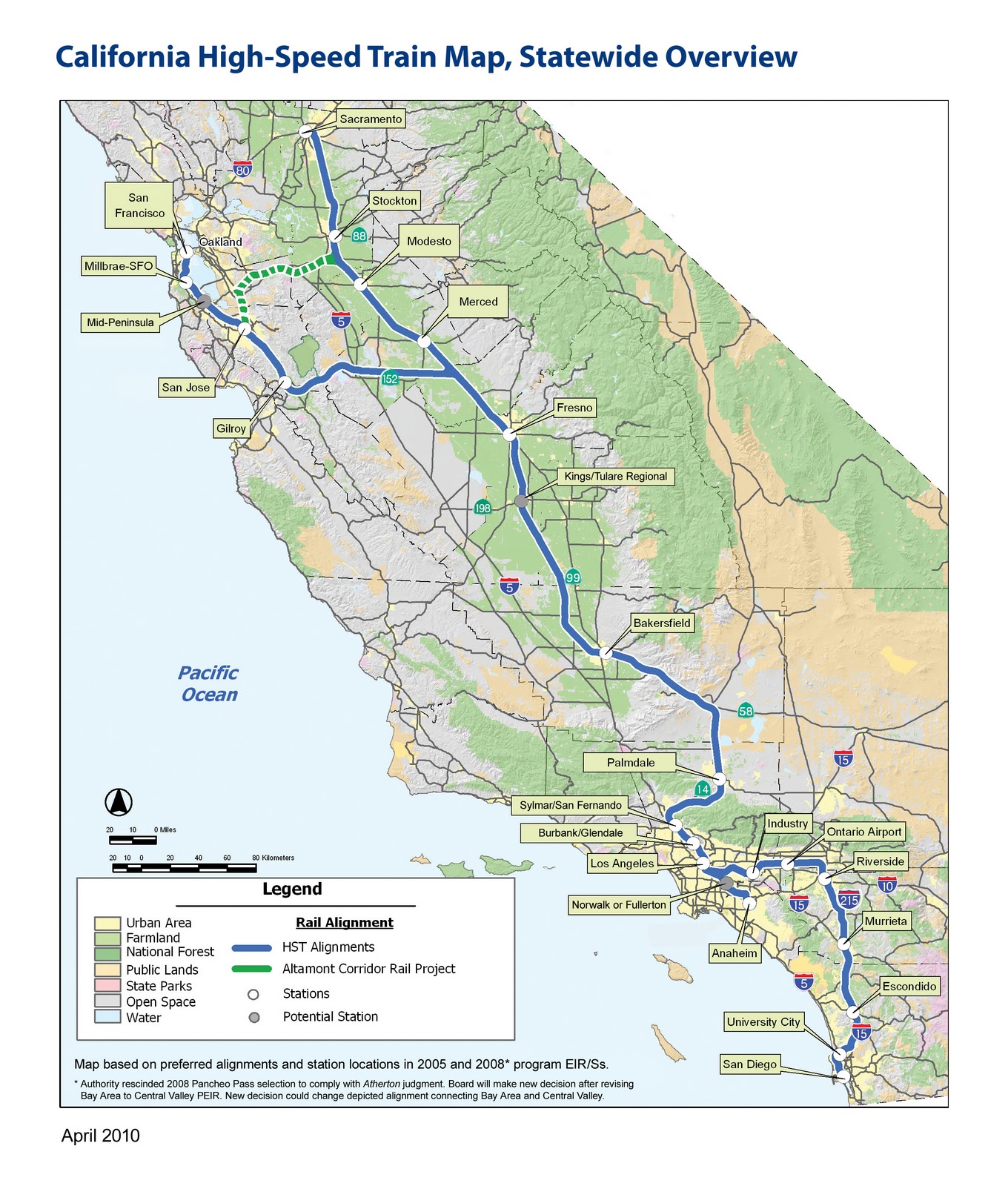
The San Francisco Planning and Urban Research group (SPUR) hosted a lunch forum today in which it presented 13 recommendations for land use plans around future/hypothetical CA high speed rail stations.

A fully funded network will have 26 stations, serving cities that contain the vast majority of the state's residents

After a general overview of HSR, and some caveats--these recs are "bird's eye view," they won't get into specifics of station design, alignments, etc--Regional Planning Director, and chief powerpoint clicker Egon Terplan got down to business. The recommendations turned out to be fairly unsurprising, at least for anyone familiar with the work that SPUR does, yet certainly good, worthy, and salient. The presentation left me hankering for a longer format presentation, one that would delve into the site-specific details of individual station areas. That's where the real creative/pragmatic alchemy would be, not in a list of general principles--I mean, find me a planner who would disagree with making the area around the station a "destination." Nonetheless, general principles are critical for establishing goals and expectations, so it's worthwhile to lay them out. Rather than reproduce each of the 13 recs, I'm condensing them, because let's face it, I've never been the linear note-taking type.
  • Station Area Plans for each of the 26 HSR station areas. Density minimums, parking maximums, integrated access to intermodal feeder networks.
Station Area Plans are the necessary starting point for generating maximal utility from each station. As SPUR noted, it is perfectly conceivable for HSR to follow the footsteps of BART, or airports, and become functioning transportation hubs surrounded by surface level parking and other low-rise, low-density uses. This would be counterproductive in several ways.

One, it forfeits HSR's unique ability to create incentives for denser developments, essentially giving up the potential for concentrated investment in what will typically be the city's downtown area. Two, denser uses around the station ensure higher station use: more office space, more commercial space, convention centers, high(er) rise residential will make HSR more relevant. Third, using the space around the station intensely, but also with an eye toward public spaces and the unique dimensions of each city will create good urban places. Good urban places will increase the feedback loop of investment and HSR ridership. Fourth, development at each station will help prevent the system from making CA into one big commutershed. Surrounding a station with parking and low-rise residential will only encourage riders to use HSR as a commuter train on steroids, and extend the bedroom communities of SF, SJ, and LA into the central valley. Some movement in that direction will undoubtedly occur, but far better to work toward making those places destinations and job sources in and of themselves.

Not this: North Berkeley BART

Not this either: Oakland Airport. The "A" placemarker is in the middle of a parking lot

Terplan also noted that in France, many cities lacked light rail before TGV stops were built. Presence of TGV spurred investment in local links and feeder routes, dramatically increasing the connectivity of the area as a whole, above and beyond simply getting to and from the station. An HSR station would certainly require re-jiggering local transit routed, and I'm hopeful that this could lead to some new investments and transit ridership.

A problem is that the state of CA lacks either the political will or the legal authority (different opinions were offered on this point) to mandate station plans, which leads to:
  • Financial incentives for local governments to make Station Area Plans: Matching grants, Revolving loans.
Funds are always hard to come by, but plans have the advantage of being relatively cheap. Terplan singled out general obligation bonds like Prop 84 from a few years back as initiatives that could tuck away the $1 million or so necessary for a good plan. Takeaway here is that sans incentives means cities sans resources for far-reaching plans.
  • Incentives for the type of Station Area Plan SPUR favors: TIF for TOD
Little as the state can dictate what a municipality must plan, it has less control over how it should plan. (An interesting comparison here, to Japan, where the company unrolling the HSR there also had a real-estate development arm that got to plan areas around the station just how it wanted. Nice.) Tax Increment Financing (TIF; TOD stands for Transit Oriented Development) is a tool I've already documented, and certainly a way for cities to capture the value of HSR. Read: shake the money tree. Only problem is, in order to establish a TIF zone, you need to show evidence of blight. Terplan mentioned that a few years ago there was a drive to introduce legislation that would classify HSR stations as sufficient grounds to create a TIF zone. Were this to be revived and passed, public and private bodies would have lucrative incentives to make areas around HSR into high yield places. Another obstacle: many areas around stations are already part of an existing TIF zone, and thus their tax revenue is already spoken for. And all this assumes that the best way to use this land is with the uses that will generate the highest property tax revenue ... this would have substantial transformative power, but little power to preserve the existing character of a city. While investment and prosperity are great, it would be a shame to see the homogenization this could unleash if improperly handled. To say nothing of gentrification.

Another potential strategy the presentation mentioned was land banking. This sounds like free market eminent domain, as Terplan described the process as buying up land around the future station site in order to have more direct control over the kind of development that takes place on it. Such a move would likely be a wise investment by whatever party doing the buying, though in the ideal, local towns and cities would have the say.
  • Implementation Program
How would a city move from Station Area Plan to reality? Provisions would be needed for updating local General Plans in accordance with Station Area Plans--zoning laws being perhaps the most relevant. Some streamlining of permit acquisition and Environmental Impact Report requirements was also discussed, provided that a project fit within the recommendations of the Station Area Plan. Additionally, a financing plan and assessment district structure could generate revenue to operate the HSR station.
  • Oversight and preservation
I don't have as much detail on these, but accountability matters, so I thought I'd give it a shout out. My notes shout out the HSR Authority, Caltrains, HCD amd OPR as hypothetical oversight agents, though what they would be empowered to do is entirely unclear. Preservation was mostly framed as preserving agricultural land against potential sprawl. Urban growth boundaries and agricultural easements could mitigate this, though the process of putting those in place would likely fall completely to local governments.

Given that local municipalities exercise control over local planning issues, and the absence of a robust incentive system, HSR seems fated for divergent station outcomes. Some will likely generate sprawl, surface parking, commuting, and bedroom communities, while others will change city centers into places more along the lines of SPUR's vision. Assuming the whole project even gets built, which is still a big assumption.

October 29, 2010

CA Redevelopment Law: Can a Powerful Tool be Repurposed?

Caveat Emptor: this is a wonkier post, so read at own peril.

Earlier this month, I had the privilege of attending the Berkeley Dept of City and Regional Planning (DCRP) open house, where I sat in on a class titled "Sustainable Redevelopment." Professor Cecilia Estolano, the recent former Executive Director of the Los Angeles Community Redevelopment Agency (CRA/LA), taught the class.

The class outlined the system of redevelopment in California. Briefly, and hopefully without too many mischaracterizations, let me set the three main redevelopment tools in CA law: 1) Community Redevelopment Agencies, which have authority to buy and assemble land, 2) Tax increment financing, which provides the strong profit motive for the CRAs, and 3) eminent domain, which among other things, also keeps costs down for redevelopers.

CRAs

California state law provides for the existence of locally derived Community Redevelopment Agencies. They are not centrally administered, and though there is a central body, the federalist structure retains significant independence for each CRA. According to Estolano, a lot of cities that are too small for a city council and a CRA will fuse the two bodies, such that a copy of the meeting minutes might read "Move to close City Council meeting. Motion appoved. Motion to Open CRA meeting. Motion approved" or something similar. The decentralization can also create a situation where smaller CRAs lack legal, real estate, and economic expertise sufficient to combat pressure from external developers. But onward:

CRAs were originally tasked with reducing blight. The definition of blight, however, was/is problematic: to be blighted, an area had to show physical and economic blight. Criteria included overcrowding, unsafe, unhealthy, or poorly maintained building stock, low property values, even irregular lots with under multiple ownership. (Picture Boston's North End, which thankfully weathered a redevelopment storm of its own, or any other district with "European" narrow/angular street patterns and residential/retail mixed use.) Redevelopment Agencies had to establish a relationship wherein blight caused a lack of utilization, that without public-private redevelopment, would lead to further stagnation.

Such a liberal definition of blight gave Redevelopment Agencies (in my notes as RDAs, not sure if these are technically identical to, or different from CRAs) the authority to declare a project site "blighted." Sidenote: not sure what the accountability structure is here, ie, who or what evaluates RDA blight designations. In practice, the law gave redevelopers the ability to take control of low-income areas for the purposes of redevelopment.

Tax Increment Financing (TIF)

With the land assembled, CRAs needed funds to fuel the projects intended to better utilize the blighted zones. Enter TIF, which allows the CRA to accumulate funding by leveraging future increases in property values in the project sight as collateral. The first step is to assess existing property values in the project area--these revenues, pursuant to state law, are divvied up among local bodies like the schools, libraries, etc. But above this baseline, all growth in tax revenue accrues to the CRA. Needless to say, this arrangement creates incentives for projects that will boost property values the fastest: skyscrapers, big box stores, and luxury this's and thats's. Any regard for previous residents of the project site is notably absent, as is any eye for social justice, social services, or even any doubt that boosted property values are one and the same as economic development. A subsequent law required that increases in tax revenue be subject to the same redistribution formulas as the baseline tax revenue, but the incentives are the same regardless of whether local institutions do or do not get to share the windfall.

Because the CRA is a public agency, it can get sweet rates on the bonds it purchases. And it can only use the money inside the project zone, giving rise to disparities of community investment. And CRAs are chartered for 45 years, which allows them to reap the TIF driven money tree for a substantial amount of time.

Eminent Domain

Enough has been said about this already without me needing to add much. The ability to requisition property from private owners for a larger project, be it a highway or a stadium. Eminent domainers have been historically required to pay only fair market value for the property, which, because it is frequently in a designated blighted area, is frequently inconveniently low for the property owner.


Overall, a powerful framework for redevelopment. Needless to say, incentives are aligned in favor of the monied few, and against the non-monied multitude, but the essential question to be asking is what provisions can be added or subtracted from this framework to create redevelopment projects that value context, value social and environmental justice, and value reduced carbon footprints?